


How Developing Executive Function Skills Can Help Teens Manage Device Use.

A student settles down to write, the familiar glow from the laptop. The document opens, and with it, literally everything else. The tabs multiply, messages beckon from the phone nearby, and the urge to watch a quick video or scroll. Forty minutes drift by, leaving behind eleven open windows, several group chat replies, 5 finished videos, and sixty tentative words on the page.
There is nothing unusual in this scene.
More than half the world's education systems now restrict phones in school. Schools have tightened up, putting devices into lockers, bags or trays, often for the whole school day.
It is a sensible rule. It also answers the easier question.
The real challenge isn’t the school day, and it’s not just about the smartphone and the applications. It’s every moment a student must independently choose between doing the “work” they have to do (very often homework, studying, or online tuition) and getting pulled into the device the “work” is on.
This happens at multiple points throughout a teenager's day. In their bedroom, in the “forever” showers or numerous breaks to the toilet, between lessons, in transit, when they are bored, where there is no activity, when there is no adult supervision, when everyone is asleep, every day through the weekend and across the holidays.
While you can lock the phone and limit apps, the fact is the laptop is both the tool for schoolwork and the source of every distraction. Homework and temptation, side by side on the same screen.
We can manage the device with rules and boundaries. But it’s Executive Function that helps young people manage their behaviour around it.
Growing Up Means Growing Executive Function Demands
The challenge does not end when school does. In fact, as students move towards university, further study, or their first job, the external structure that has supported them gradually falls away while the demands on their Executive Function quietly increase.
Building these skills now gives young people something to draw on when that structure is no longer there. The routines, strategies and habits they develop become the foundation for greater independence, resilience and confidence in managing life for themselves.
For parents, the goal is therefore bigger than getting homework finished or keeping screen time under control. It is about helping young people develop the skills to organise, regulate, and manage themselves when no one is standing beside them to remind them what to do.
A student who has learned to manage their own attention carries an advantage far beyond the classroom and beyond their grades.
That is why these skills are worth developing before the pressure becomes urgent. The habits formed at 16 can still shape how a young person functions at 22, only then, the demands are greater, the consequences more significant, and there may be no one around to notice when things begin to unravel.

What the Problem Actually Is. Device Rules may Cover School Hours; Executive Function Has to Cover the Rest.
School provides a great deal of built-in structure: a timetable, a teacher, a classroom, and someone likely to notice when a student loses focus. But that structure has clear boundaries. Before school, between lessons, after the final bell, at weekends and during holidays, much of it disappears.
And even at school, the rules can only go so far. A phone may be put away, but the laptop still needs to stay open because that is where the lesson, assignment or learning platform lives.
This is where the real challenge emerges. Executive Function must carry the student through the hours that a timetable does not cover and the situations where a device cannot simply be removed. Work and distraction often sit on the same screen.
The student must decide, moment by moment, which one gets their attention.
A student still needs to stop something rewarding when it is time to work, tolerate boredom, begin something that feels difficult, sustain attention, and recognise when far more time has passed than they intended. These executive function skills continue to develop throughout adolescence and into early adulthood.
That matters because struggling with these skills is not necessarily a sign of laziness, poor motivation or a lack of discipline. Adolescence is a period of significant development, and self-regulation, planning and impulse control develop gradually. Young people need opportunities to practise these skills, along with the right amount of structure and support.
For parents, understanding this distinction can change the conversation.
Instead of asking, “Why can't you just put the phone down?”, we can begin asking, “What skill is making this difficult, and how can we help you build it?”
This is a skill gap.
And skill gaps can be taught.
But before we can teach the skill, we need to understand the pull. Why does a device make stopping so difficult in the first place? Why can a student know exactly what they should be doing and still find themselves scrolling, gaming or checking messages instead?
The answer is not simply that teenagers lack discipline. The devices themselves are designed to compete for attention, and they do it very well.

Why Students Go There. Emotional Regulation and the Four Needs
One of the most useful shifts for parents is to move beyond the question, “How do we get them to stop?” and ask instead, “What is drawing them there in the first place?”
In his TEDxBoulder talk, Escaping Video Game Addiction, Cam Adair draws on his own experience of problematic gaming to explore the needs that gaming can meet. His four needs provide a useful lens for understanding why digital activities can become so compelling, particularly for young people whose Executive Function and self-regulation skills are still developing.
1. Escape — A way to regulate difficult emotions
Gaming, scrolling or moving between endless tabs can provide a quick way to step away from stress, boredom, frustration or other uncomfortable feelings. From an Executive Function perspective, the device is serving a regulatory purpose. The difficulty is that it provides relief almost immediately, making it much harder for another strategy to compete.
2. Social connection — Belonging without the same social demands
Online spaces can offer friendship, community and a sense of belonging. For a young person who finds face-to-face interaction tiring, complicated or demanding, the digital world may feel like an easier place to connect and participate.
3. Challenge and purpose — Goals that are clearly structured
Games make the next step obvious. There is a mission, a level, a target or a problem to solve. Progress is broken into manageable steps. Compare that with an essay, a revision plan or an internship task where the goal may feel distant and the first step unclear. This is often where task initiation and goal-directed persistence become much harder.
4. Visible progress — Immediate feedback and reward
Games constantly show players that they are making progress: points increase, levels unlock, achievements appear, and goals are completed. Real-life learning often works differently. A student may spend hours revising or working on a long-term project without seeing an obvious reward until weeks later.
This is an important distinction.
The device isn't simply competing with a young person's willpower. It competes with activities that may feel less clear, less rewarding, and much harder to start.
That is why the coaching question becomes so important.
Rather than focusing only on how to remove the behaviour, we can ask what function it is serving. What is the young person getting from it?
Relief? Connection? A sense of achievement? A clear goal? Immediate feedback?
At NICE, this is central to our coaching approach, understand the behaviour before trying to change it, identify the underlying need, and then help the young person develop other ways to meet that need.
For parents, this can create a very different conversation.
Instead of beginning with “You've been on that game for too long,” we can begin with “What is the game giving you right now?”
That question does not remove boundaries. It helps us understand what needs to sit alongside them.
And for many young people, the four needs are a much easier place to begin a conversation than a debate about screen-time hours.
Where Executive Function Fits and What Else Is Driving Device Use
Executive Function is an important part of the picture, but it is not the whole picture. Any discussion that suggests otherwise oversimplifies reality for parents.
The design of digital products matters. So do sleep, stress, emotional wellbeing, the social pressure to stay connected, and the role devices play within a particular family. A young person's learning or attention profile can change the picture again.
For students with ADHD, autism, anxiety or other learning differences, device management may need to be adapted to their individual strengths and areas of difficulty. They may benefit from more visual scaffolding, shorter periods of focused work, more frequent movement or regulation breaks, or assistive technology that reduces unnecessary cognitive load.
And when a student is already working with a psychologist, counsellor, educational therapist or school support team, Executive Function coaching should complement that support rather than replace it.
Executive Function Coaching works on the skill side of the equation. It cannot redesign an app, remove every distraction, reduce an unrealistic workload or resolve everything else happening in a young person's life.
But the skills still matter.
Because unlike a school rule, a parental boundary or a particular app, executive function skills belong to the young person. They travel with them. They can be practised, strengthened, and adapted across different environments, including moments when the rules, the apps, and the adults are no longer there.

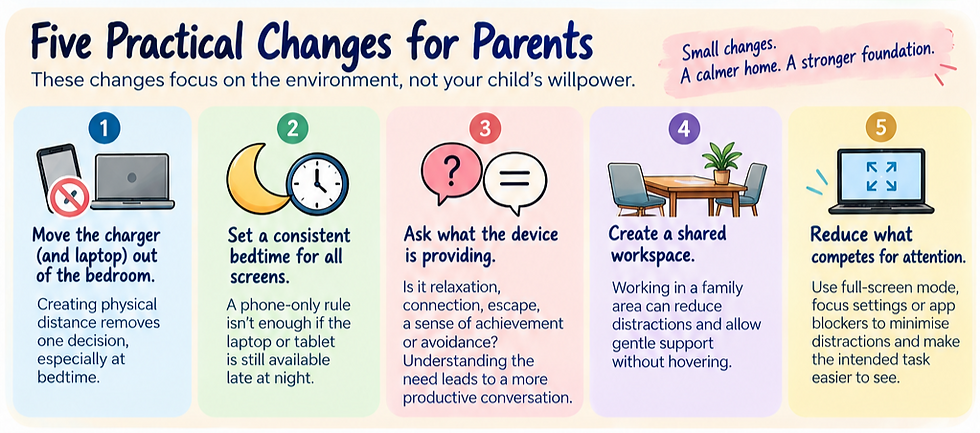
What Can Parents Do? Five Practical Changes.
If you take only a few things from this article, start here. These changes focus on the environment rather than asking your child to exercise more willpower in the moment.
1. Move the charger and, where possible, the laptop out of the bedroom.
Creating physical distance from devices removes one decision the young person has to make, especially at bedtime.
2. Set a consistent bedtime for screens, not just for the phone.
If the laptop or tablet remains available late into the evening, switching off the phone alone may not create the boundary you intended. A whole-screen routine is often more useful than a phone-only rule.
3. Ask what the device is providing before focusing on how long it is being used.
Is it helping your child relax, connect, escape, achieve something or simply avoid a difficult task? Understanding the function of the behaviour can lead to a much more productive conversation about change.
4. Create a shared workspace where possible.
Homework does not always need to happen behind a closed bedroom door. Working at the kitchen table, in a family workspace, or alongside a parent doing their own quiet work can reduce distractions. It also allows parents to offer a gentle prompt without hovering.
5. Reduce what competes for attention on the screen.
Full-screen mode, focus settings, and appropriate app or website blockers can reduce visible distractions while a student is working. The goal is not to control every click. It is to make the intended task easier to see and the distracting alternatives less immediately available.
These are environmental supports, not substitutes for skill-building. They reduce the load while the young person learns to manage more of it on their own.
And that brings us to the practical question: what does it look like to build those skills?
From Managing Devices to Building Skills
The answer is not to remove every distraction, create tighter rules, or expect a teenager to suddenly become highly self-regulated because we have explained the consequences.
It is to gradually move from managing the environment for them to helping them learn to manage themselves within it.
That takes time. I am not talking weeks but many months.
A young person may need the phone moved out of reach before they can learn to resist checking it. They may need a visual plan before they can organise their workload independently. They may need a parent to sit nearby before they can sustain attention on a difficult task. They may need shorter work periods, clearer starting points and regular opportunities to experience success before they can manage a longer block independently.
None of this is a failure of independence. It is how independence is built.
Executive Function develops through practice, reflection and gradually increased responsibility. We provide enough structure to make success possible, then slowly hand more of that responsibility back to the young person.
The question shifts from:
“How do I stop my child from being distracted?”
to:
“How do I help my child notice distraction, understand what is pulling them away, and develop strategies to return to what matters?”
That is a much bigger goal than screen-time management.
Because eventually, there will be no school phone policy. No parent standing outside the bedroom reminding them to put the laptop away. No teacher checking whether they started the assignment. No one watching the clock.
There will simply be a young adult with a device, a deadline, competing demands and a choice about what gets their attention.
That is the skill we are really trying to build.
Not perfect self-control.
Not a device-free childhood.
But the growing ability to notice, pause, choose, adjust and take ownership of their attention.
That's where Executive Function Coaching can make a meaningful difference, helping young people understand how their brain works, identify where they get stuck, experiment with strategies that fit them, and gradually build the capacity to manage more for themselves.
The goal is not to make the scaffolding permanent.
It is to build the skills that eventually make the scaffolding less necessary.
My name is Shyla Mathews, Founder of NICE Executive Function Coaching & Educational Therapy. I am a trained and experienced Youth Coach, Executive Function Coach and Educational Therapist, and I am also a mother of two young adults, aged 19 and 17.
I understand the professional perspective, but I also understand the reality of being a parent; the reminders, the negotiations, the worry, the frustration and the hope that our children will eventually learn to manage things for themselves.
I get it.
That's why I believe the goal isn't simply to manage our children's devices. It is to help them build the skills to manage themselves.
References
• UNESCO Global Education Monitoring Report team (2025–2026). To ban or not to ban? Monitoring countries' regulations on smartphone use in school. world-education-blog.org
• Adair, C. (2013). Escaping Video Game Addiction. TEDxBoulder.
• Casey, B. J., Jones, R. M., & Hare, T. A. (2008). The adolescent brain. Annals of the New York Academy of Sciences, 1124, 111–126.



Comments